

Archaeological sites
Gallo-Roman villa Bufosse
Excavations in Verneuil-en-Halatte have uncovered a Gallo-Roman villa known as Villa Bufosse. This farm developed on the site known as Bufosse and was in use from the 1st to 4th centuries BC.
A range of bronze artefacts, including coins and fibulae, are on display in the Musée de la Mémoire des Murs et des Hommes (Museum of the Memory of Walls and People).
The Halatte Temple
In the Halatte forest, a Gallo-Roman temple dating from the 1st century AD, dedicated to healing and fertility, was discovered during excavations in the 19th century.
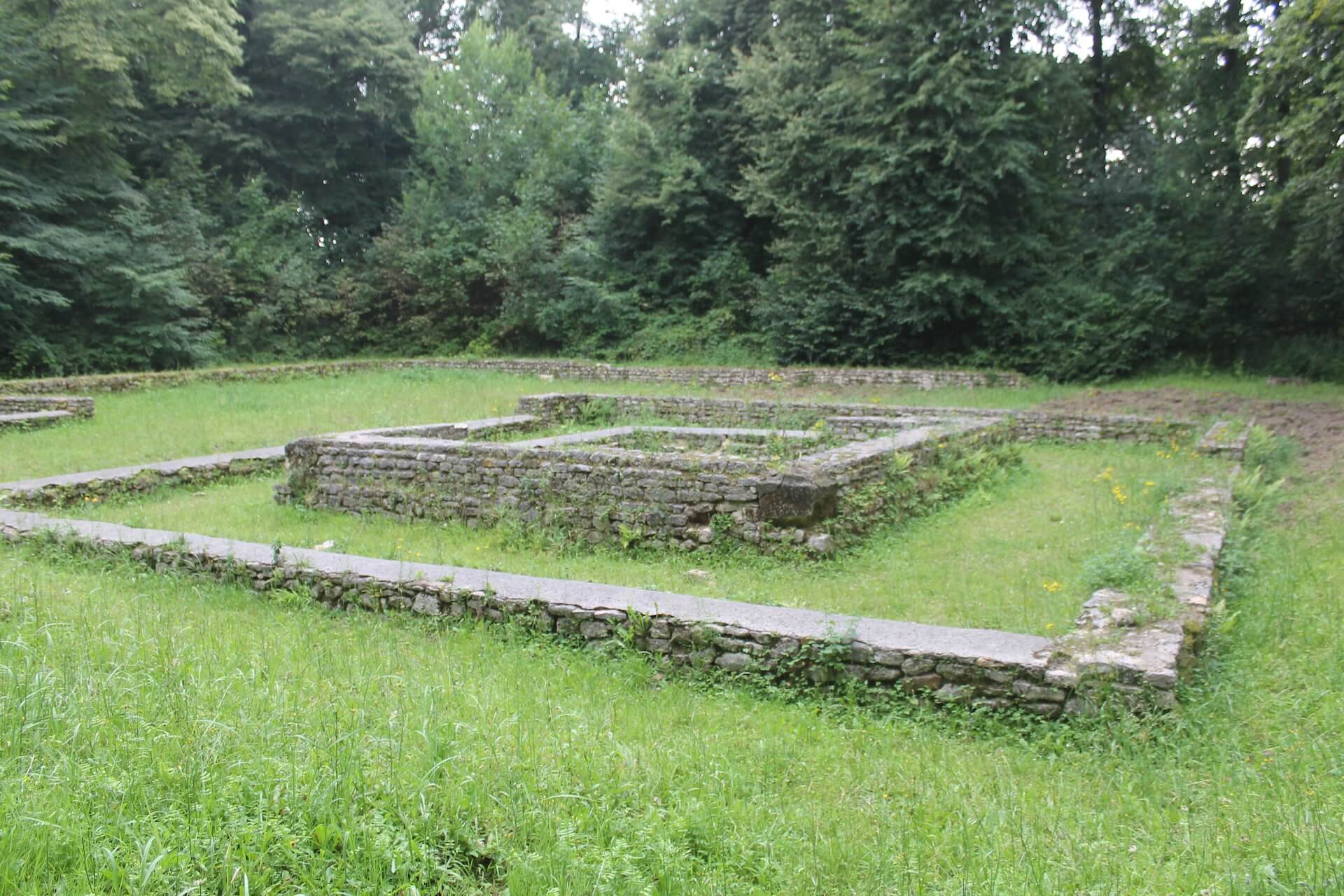
More than 350 stone and metal votive offerings were discovered during excavations at this temple. Sick people made offerings of statues, pottery and coins.
The ex-voto and other objects are on display at the Musée d'Art et d'Archéologie in Senlis.
A Roman sanctuary
In 2014, excavations in Pont-Sainte-Maxence uncovered an exceptional ancient monumental sanctuary dating back to the 2nd century.

It consisted of a surrounding wall with statuary unrivalled in Roman Gaul, and a temple at its centre with a statue of a deity inside.
It was ideally located on the outskirts of the town of Levandriacus and on the Roman road "la route des Flandres" linking Paris to Belgium (now Route Départementale 1017).
More information on inrap.fr News reports on archaeology. Pont-Sainte-Maxence: exceptional discovery of an ancient monumental sanctuary | Inrap
Our buildings at the heart of history
Our many churches, built from the 11th century onwards, are a real eye-catcher, with their charming setting, bell towers and stained glass windows.
Take time to appreciate and admire the region's châteaux and other private residences.

Le Beaurepaire castle is one of the oldest and most picturesque in the region. It invites you to take a journey through time.
That of Roberval dates back to the 16th century and was remodelled in the 18th century in an essentially classical style.
Pont-Sainte-Maxence has two brick and stone châteaux. The château Primet dating from the late 19th century, belonged to Claude Primet, the inventor of the "aluminium saucepan". The Château de Villetteentirely rebuilt by the Edgard Stern family in 1903 in the neo-Renaissance style, was originally designed for the Marquis Charles de Villette and his wife Reine Philiberte, Voltaire's ward.
From the castle of Verneuil-en-HalatteAll that remains are the ruins, the plans for which were designed by Jacques Androuet du Cerceau and completed by Salomon de Brosse for Philippe de Boulainvilliers in the 16th century.
The building was demolished by its owners, the Princes of Condé, in the 17th century. All that remains today are the foundations and some of the elements preserved in the Musée de la Mémoire des Murs et des Hommes.
Industrial and art deco heritage
Following the development of the railways in the 19th century, factories sprang up across the region and took off in the 20th century.
In Pont-Sainte-Maxence, a number of factories, now defunct, made the town and surrounding area famous, including Cérabati (building ceramics), which made tiles, Salpa, which made Synderme artificial leather, and SAF (Soudure Autogène Française), which produced welding components and equipment, including the first boat made from welded sheet metal.
Under the initiative of the mayor, George Decroze, the town of Pont-Sainte-Maxence was radically transformed from 1929 onwards with the construction of buildings in the art deco style. The finest example is undoubtedly the Town Hall, with its ironwork and bas-reliefs, as well as the former baths and showers, the old post office, the hospital and the Jules Ferry school.

Famous people
Our region has inspired and witnessed the birth of great men from a wide range of disciplines.
Architects and inventors
Salomon de BrosseThis architect, born in Verneuil-en-Halatte in 1571, completed the Château de Verneuil and designed, among other things, the Palais du Luxembourg in Paris for Marie de Médicis.
Jean-Rodolphe PerronetThe architect and later engineer of the Ponts et Chaussées, known for his design of the Concorde bridge in Paris, also designed the three-arched bridge at Pont-Sainte-Maxence in 1785, which has now disappeared. He was nicknamed the Vauban of bridges and highways.
Gilles Personne from RobervalNoël-Saint-Martin, a mathematician and physicist born in 1602, invented the Roberval balance. He was one of the founding fathers of the Academy of Sciences in the 17th century.
The painters
Painters also came to the region to recharge their batteries and find new inspiration.
It was in the summer of 1908 that Pablo Picasso and his partner Fernande Olivier settled for a few weeks in La rue des Bois (near Verneuil-en-Halatte). It was here that the cubist painter found inspiration for 4 paintings (Vase of flowers and glass with spoon, La fermière, Cottage in a garden, Gilbert Krill).
The Grand Prix de Rome of 1864, Diogène Maillarta history painter, portraitist and drawing teacher at the Manufacture des Gobelins, lived in Rieux.
Men of letters
Nicolas BoileauThe poet and writer of the 17th century spent 8 years in the hamlet of Saint-Paterne in Pontpoint. It was here that he composed some of his Epistles and its Satires.
Robert Louis Stevensona 19th-century Scottish writer, whose books include Treasure Island and The strange case of Dr Jekyll and Mr Hydewho, through his navigation, tells the story of his journey in Canoe trip on northern rivers in 1878, stopping off at Pont-Sainte-Maxence.
Did you know?
A legend has given its name to the town of Pont-Sainte-Maxence. Daughter of the King of the Scots in the 5th century, Maxentius wanted to escape her marriage and ran away. Stopped by the river Oise, she threw three stones to cross. Caught and decapitated by her betrothed, she flies up in the air with her head in her hands to her burial place.